

Culture & Market
What Independence Day Means to a Nigerian Creative

In short
Nigeria became independent from Britain on 1 October 1960. It became a republic three years later. Every 1 October since, the green-white-green flag goes up across the country and across its diaspora.
For many Nigerian artists, the day is less a holiday than a question. Who are we, and who gets to tell our story?
A place where it happened
Independence was celebrated on the Lagos Race Course. In 1972, Tafawa Balewa Square was built on the same ground, with white horse statues at its entrance.
In his Tafawa Balewa Square artwork, Raknida's founder, Anthony Ezeokoye, puts those horses at the centre. It belongs to Made in Lagos, his series on the city's landmarks, from the National Theatre to the Ikoyi Link Bridge. The series treats the city as living heritage, not postcard nostalgia.
Many peoples, one flag
Nigeria is home to more than 250 ethnic groups and hundreds of languages. Its art has never been one thing. Igbo, Yoruba, Hausa, Edo and many other traditions run through the work on Raknida, each named on its own terms.
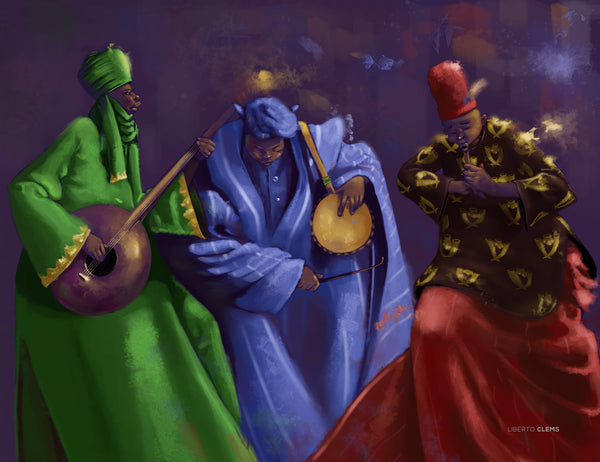
Chibuike Clement Obioha's Unity takes that on directly, bringing figures from different peoples into one frame.
Telling the story ourselves
For a long time, the images of Nigeria seen abroad were made mostly by outsiders. Today's Nigerian artists, at home and abroad, are making their own record. They draw the streets they walk, the musicians they grew up with, and the faces of people they know.
Obioha's portrait of Fela Kuti honours a musician who sang about freedom and self-determination.
What it means
For a Nigerian creative, independence is unfinished work. It is the freedom to define yourself, and the responsibility to get the story right. That is why every work on Raknida names its artist and any tradition it draws on.
Key terms
- Provenance
- The documented origin and history of a work.
Frequently asked
When did Nigeria become independent?+
From this story

Curator's Note
Before it was a square it was a racecourse, and the horses never left. Anth Ezeokoye puts the rearing horse statues at the centre of the gr…

Curator's Note
The building every Lagosian can draw from memory, its roof shaped like a general's cap, with a working crane standing beside it. Anth Ezeok…

Curator's Note
Where ethnic sentiment is used to divide, Clement Obioha paints Nigeria's three largest peoples as one band: three instruments, three voice…

Curator's Note
A homage in the caricaturist's language: Fela at the keys, eyes shut, smoke curling, a spotlight from one side and fire rising on the other…
Every Raknida work comes with its Cultural Passport — the artist, the tradition, and how it was made, documented.

Culture & Market
Interior Design Trends 2026: What’s In (and What’s Out)
The design conversation has moved past cold minimalism. These are the eight shifts shaping homes and...
For Professionals
A Designer's Guide to Raknida Trade
Interior designers and art consultants need art they can specify with confidence. Here is how Raknida...

For Professionals
How to Commission Art for a Hotel or Restaurant
For a hotel, restaurant or residence, art is part of the brand. Here is how a...

Heritage & Traditions
Why Culturally Inspired Art Makes a Home Feel More Personal
The art you display tells visitors who you are before you say a word. Work rooted...